
Major Sadness
That's what happened to me on Thursday when E.W. Scripps executives stood in the middle of our newsroom and issued a death sentence for the Rocky Mountain News. Friday was our last edition.
Friday was also the day we came in to clear out our desks. It was strange - packing up the remnants of a 15-year career in journalism. It was weird being interviewed by the Associated Press, the Wall Street Journal and local television news stations about the end of the paper's 149-year run.
I wasn't overly emotional. No tears came.
I knew this day was coming, despite the finality of the moment delivered Thursday by E.W. Scripps executives.
But then I got a call from Wes Olmsted.
In the summer of 2007, I traveled to Fort Riley in Kansas to do a profile of Maj. Andrew Olmsted. He was training with other soldiers for a tour in Iraq and, when he got over there, he was going to blog for the Rocky. My job was to write a story that introduced him to readers.
Olmsted was a smart guy. He was careful. I remember wearing the heavy helmet and the Kevlar vest that he'd be wearing and thinking he'd be just fine. I remember driving back to Kansas City with photographer Javier Manzano talking about how well prepared he was.
For months, Olmsted blogged about his experiences for the Rocky. Readers ate it up.
Then, in January 2008, he was killed. He was the first casualty in Iraq that year.
I cried when I found out. I cried when I wrote his obituary. I cried when I covered his funeral at Fort Carson. I thought about him every day since.
Then my cell phone rang Friday morning. Wes Olmsted was calling to tell me he heard about the Rocky closing and was wondering how I was holding up.
I was speechless.
Here was a man who lost his son and he was checking up on me because I had simply lost my job.
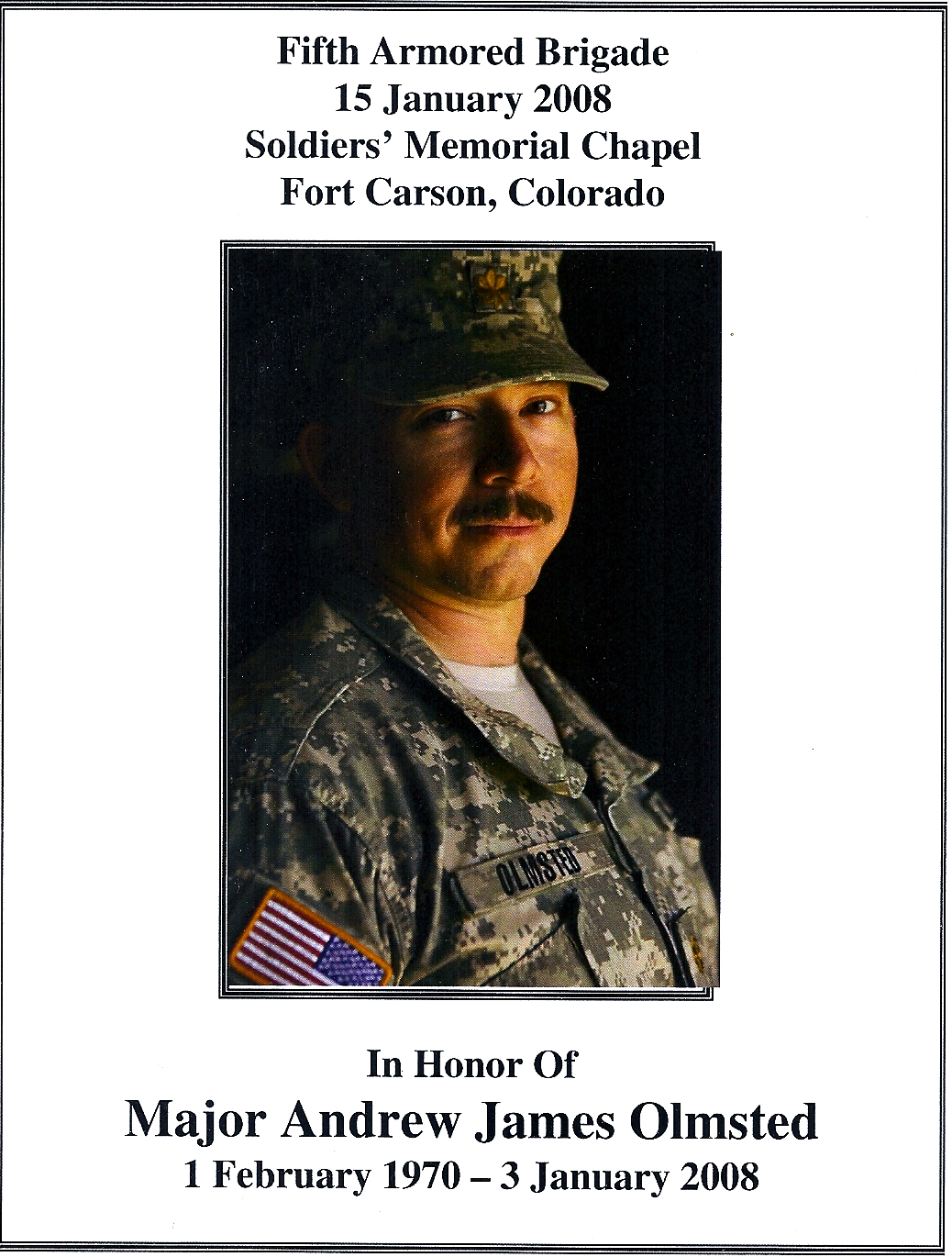
We talked for awhile as I stared at my half-packed boxes near my desk. Posted on the wall at my desk was a picture of Maj. Olmsted taken by Manzano for the funeral program.
After we hung up, Rocky reporter M.E. Sprengelmeyer came to talk to me and I told him what happened.
"You're family to him," Sprengelmeyer said.
I picked up the funeral program and clutched it tight. Then, I carefully put it in the box to take home with me. That night, sitting alone in the kitchen, I replayed it all in my mind.
And for the first time since Thursday afternoon, I cried.
(Twitter This)
-- David Montero
*** Sign The Petition ***
Labels: Posts By David Montero

posted by David Montero at 10:42 PM | LINK TO THIS POST | Follow Us @ Twitter






0 Comments:
Post a Comment
<< Home